Xyne had an AI product and no users. New plan: build the tool everyone opens every morning, get the company inside it, then sell the AI.
- Role
- Interviewer on 16 of 49 sessions (largest share), synthesis and readout
- Timeline
- 28 Oct – 1 Dec 2025
- Method
- Semi-structured interviews, workflow mapping, competitor teardown
- Corpus
- 49 sessions · 9 functions · 11 interviewers
- Status
- Phase 1 complete, feeding roadmap
The job: learn how every team really uses Slack, Jira and Zoho, well enough to build a replacement nobody has to be talked into. Low switching cost, but solving something those tools never did.
49 people, 5 weeks, 11 of us asking
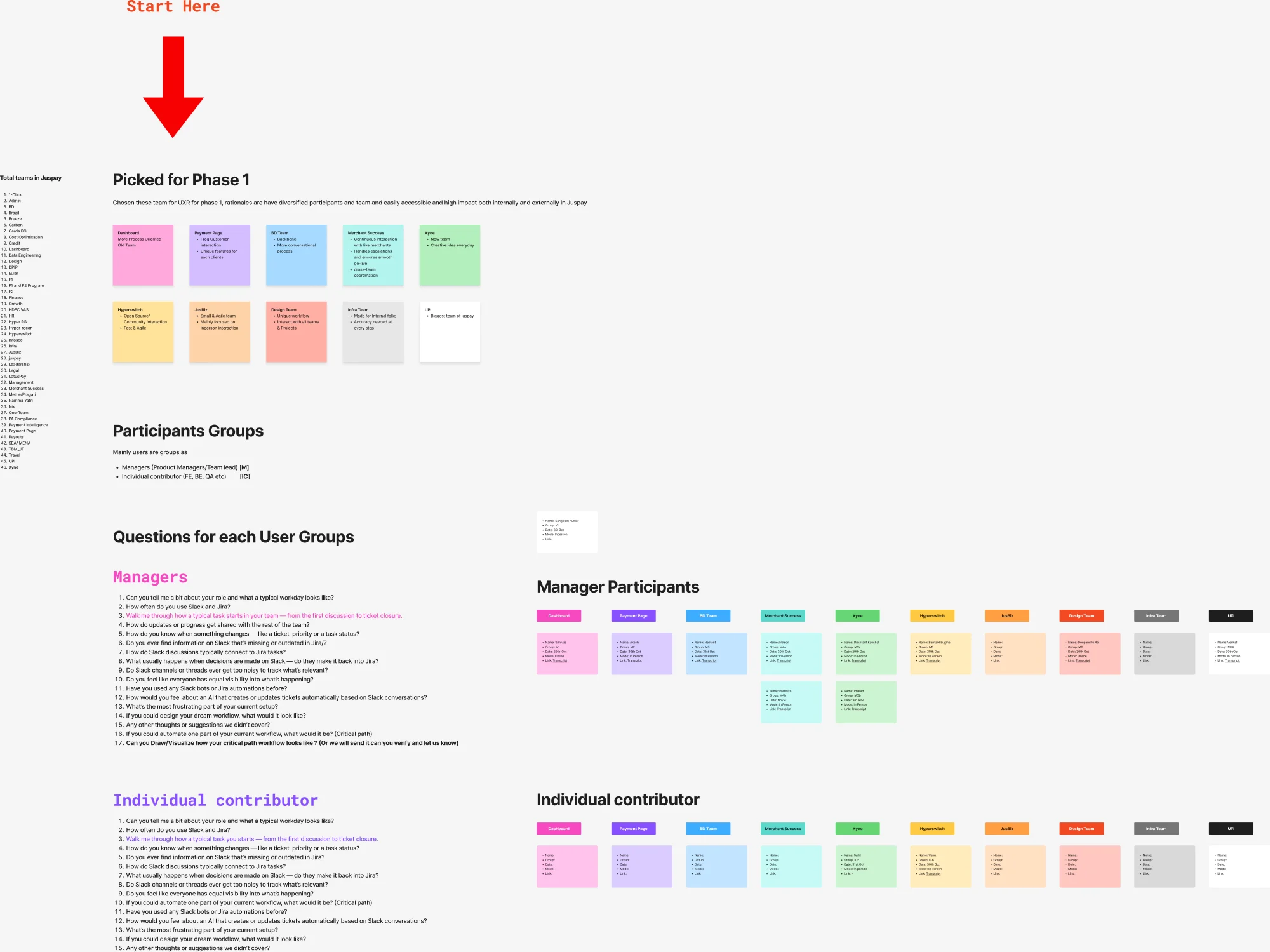
Ten of ~45 teams, split into managers and ICs, each with a 16-question guide: your day, a task from discussion to closure, how updates travel, what you'd automate.
| Function | Sessions | What they gave us |
|---|---|---|
| PM / APM | 14 | Ticket lifecycle, bandwidth blindness |
| Merchant Success / Support | 8 | The cross-team pipeline, SLA automation |
| Engineering | 6 | PR queues, bot ownership |
| Design | 5 | Figma↔Jira dead end |
| BD | 5 | Counter-evidence: no tracking needs at all |
| Ops / HR / Admin / Finance | 4 | The only hands-on beta trial |
| Growth / Marketing | 3 | Notification tiering, search give-up point |
| Infra / SRE | 2 | Assignment-bot decay |
| Xyne team | 2 | Internal requirements |
- Pick interviewees
- Plan guides
Google Docs
- Interviews
- Post-interview synthesis
- Competitor analysis
Granola · Gemini notes · GPT · FigJam
- Storytelling readout
- Fill gaps
- Roadmap handover
Slack is where work happens. Jira is where it's recorded, badly.
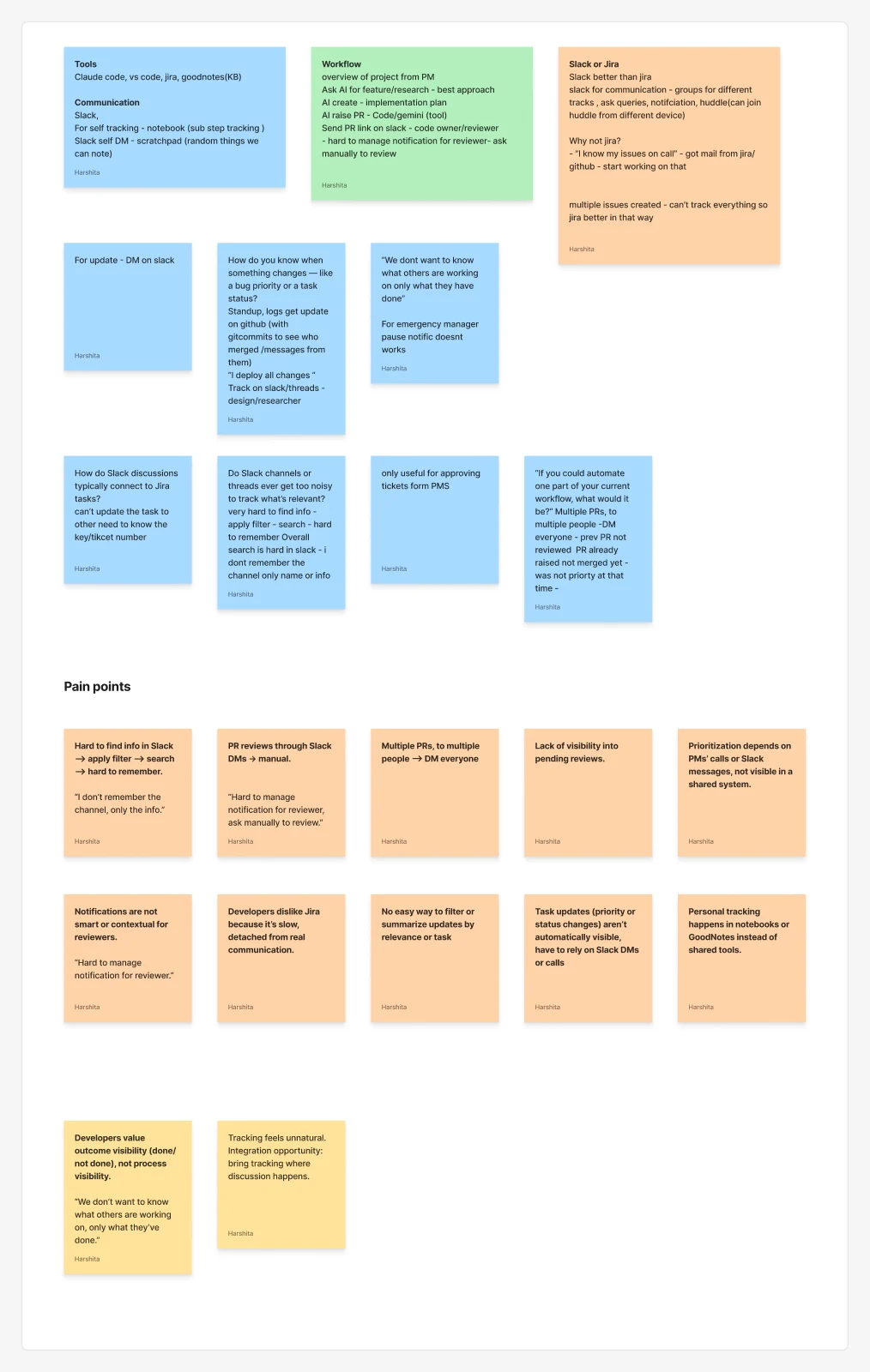
On design, 8–9 of 37 people update Jira. UPI left it for a Google Sheet. Merchant support files 2–3 tickets per 10 issues. Every team had tried a tracker and walked back.
| Team | Path | Why |
|---|---|---|
| Xyne | GitHub Issues → Linear → Jira | Linear user limits |
| Visual | ClickUp → Jira → Slack | Stakeholders wouldn't sign up |
| UPI | Jira → Google Sheet | Jira needed 10+ columns |
| Merchant Success | Jira → Pulse (+ Zoho) | Moving to dashboard-native tickets |
| Hyperswitch | Jira → GitHub boards | Open-source, still drifts to Sheets |
| Design | Tried 5 trackers | Slack wins on adoption alone |
Teams had already built twelve bots
| Bot | Team | What it does |
|---|---|---|
| Tara | Dashboard | Slack form → Jira ticket + thread. ~50% less manual ticketing |
| Alfred | SRE | Round-robin ticket assignment |
| Spot | Payments | Checks bandwidth sheet, then assigns |
| Albert | UPI Backend | Round-robin PR reviewers |
| Auditor | Dashboard | Overdue-ticket PDF for stand-up |
| ACL bot | Dashboard | Access request → approval → audit ticket |
| Sam | HR | Interview feedback from Slack |
| Intake bot | Visual | Slack-native tasks, replaced ClickUp and Jira |
| +4 more | Various | Alerts, email drafts, debugging, utilities |
Twelve teams had already built the loop we wanted to own. We were not inventing it, we were collecting it in one place.
What we heard
Decisions don't round-trip
Settled in threads, never reach the ticket.
Retrieval, not capture
Everything's in Slack, nothing's findable. One person gives up after 15–20 min.
Bandwidth is invisible
Bots count tickets, not load. Nobody can answer "who's free?"
Notifications are loud
Muted channels still ping. Bot and human mentions look the same.
Docs don't survive
Decisions live in long-tenured heads, not records.
Designers are stuck
15–20 Figma comments per file never make it into Jira.
What changed our minds
The competitor is a spreadsheet. It opens instantly and asks nothing. If ticket creation isn't near-instant, the sheet wins again.
Nobody's real to-do list lives in a company tool. Apple Notes, self-DMs, sticky notes. That personal layer is unowned.
The strongest need was one nobody asked for. Eight people described failed search without calling it search. HR's beta trial failed on exactly that.
People trust AI until it acts without them. Create it, but let me confirm. Build the confirm step in from day one.
Handoffs are the expensive part. Merchant work crosses four teams, and context gets retyped at every boundary.
Not every team is hurting. BD and a small growth team were fine. We sequenced by pain.
Merchant Success was the outlier
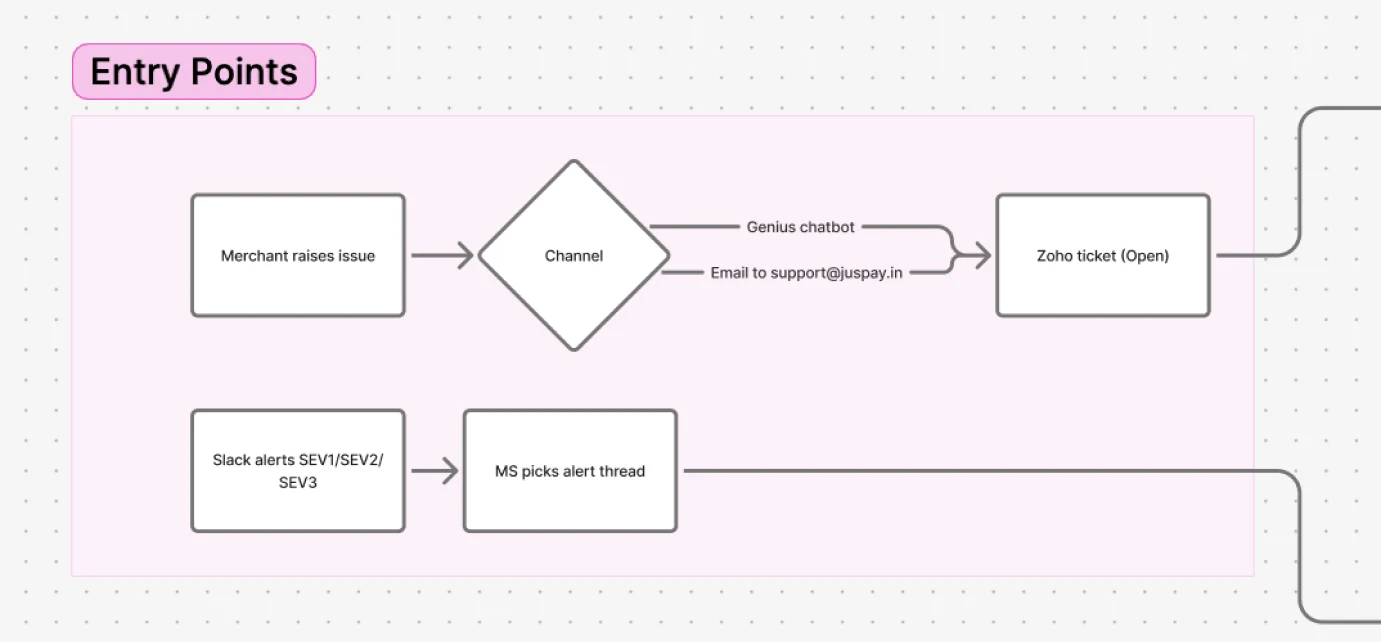
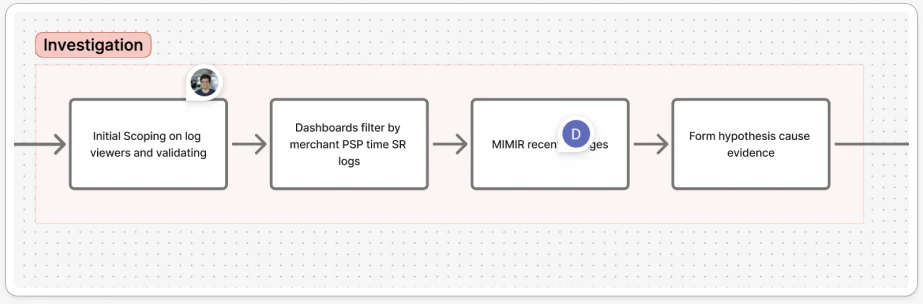
Most teams run discuss, decide, build, ship. Merchant Success runs a relay that starts outside the company, crossing four teams and five systems. Every tool seam at Juspay shows up in one of their tickets.
scroll or pinch to zoom, drag to pan
1 · Two front doors
2 · An LLM sorts it, a human checks it
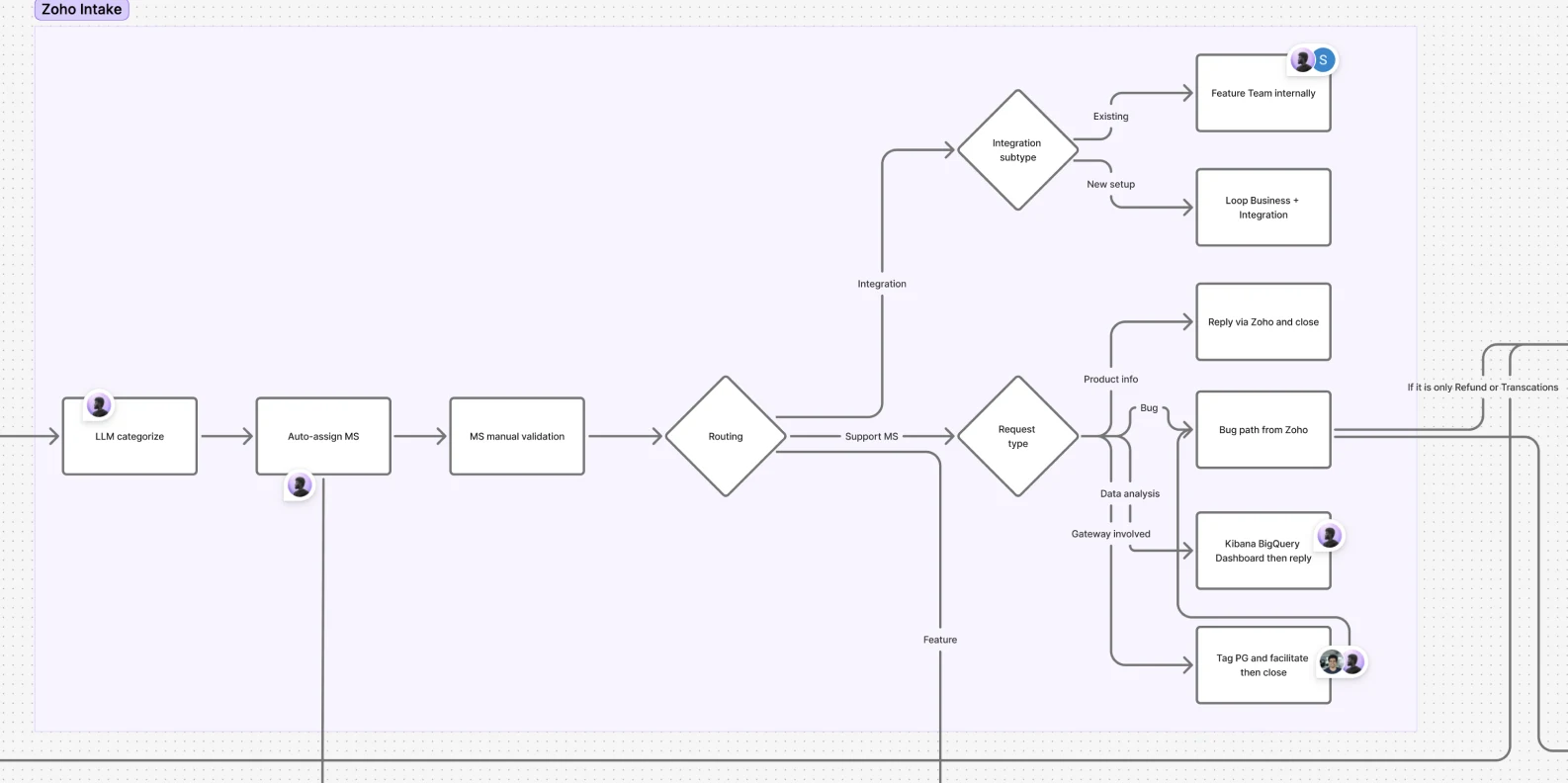
3 · Six tabs open
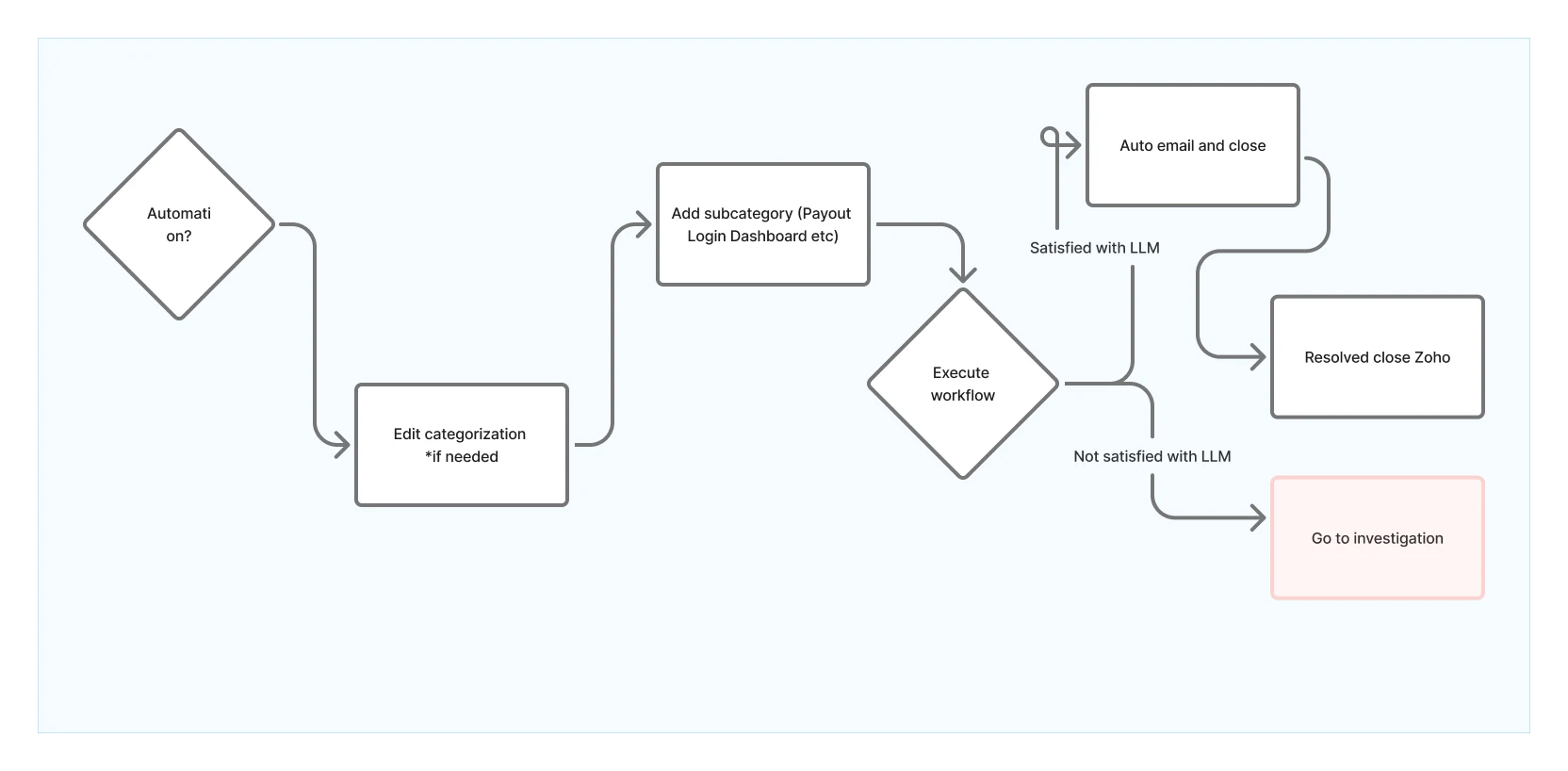
4 · Resolution
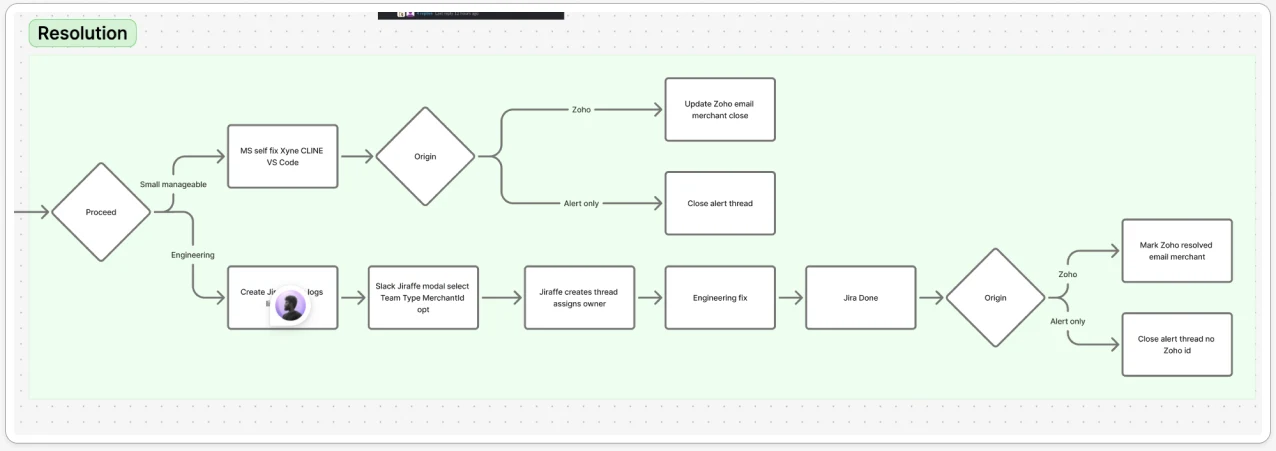
At the end, the person has to remember which front door the work came in through. One pattern worth keeping: the alerts bot posts the resolution back into the thread, so the thread becomes the record.
Problems, ranked by the team's own SEV scale
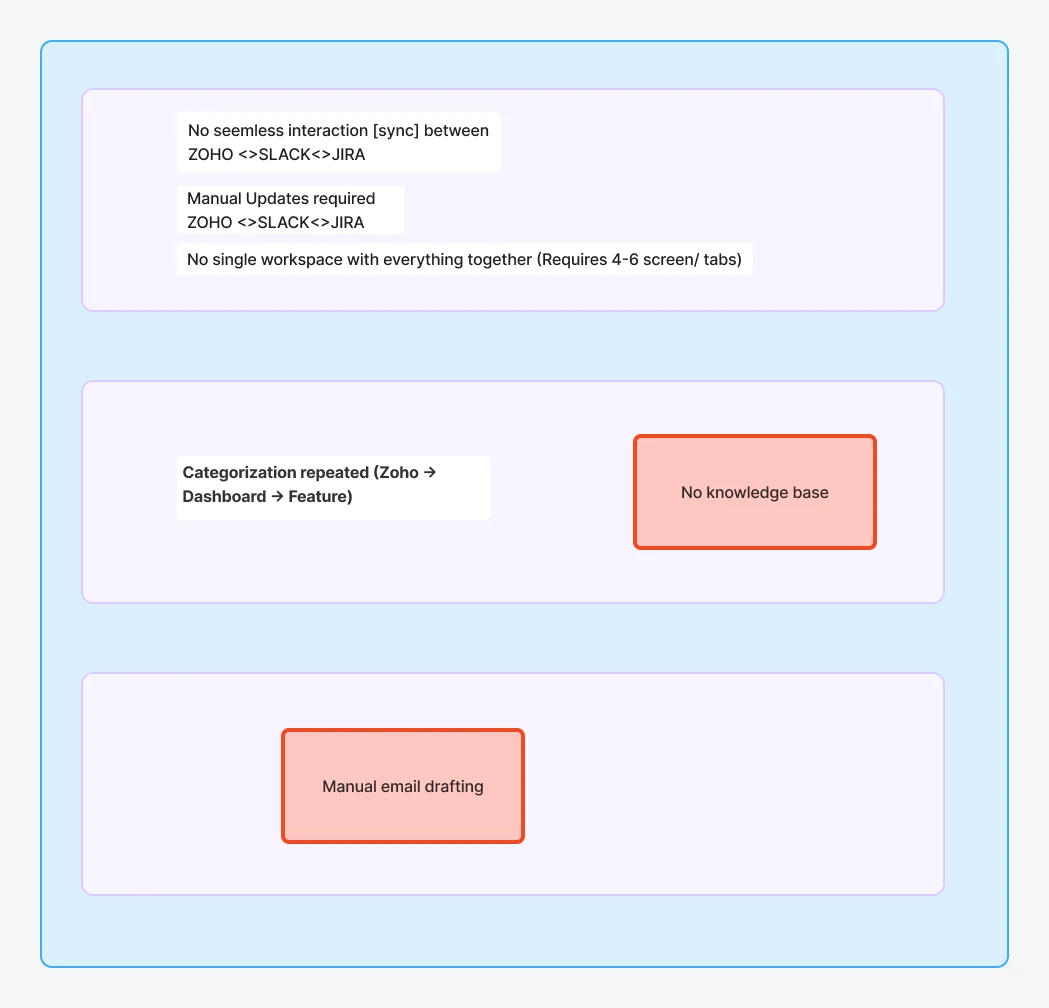
| Severity | Problem | Response |
|---|---|---|
| SEV1 | Zoho, Slack and Jira need manual syncing; 4–6 tabs per ticket | One workspace with every tool embedded; Zoho updates itself when Jira resolves |
| SEV2 | Categorised three times, then forgotten | Categorise once, route with priority; resolved tickets become searchable KB pages |
| SEV3 | AI email drafts get rewritten | Draft from the ticket's actual details; review and send |
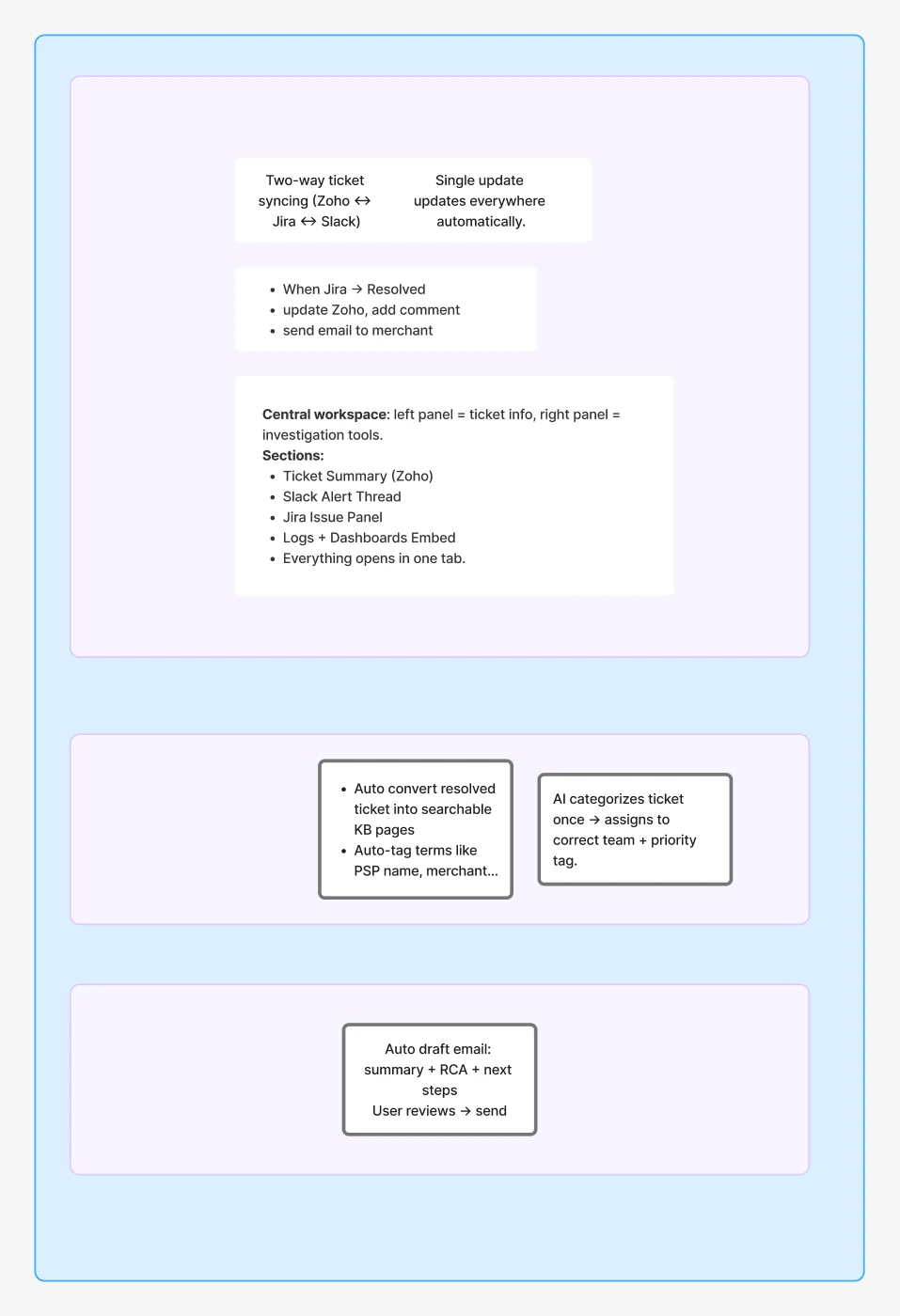
None of this asks anyone to work differently. A workspace with all four tools inside it is not a better Jira, it is the first place the whole ticket can actually live.
What each finding changed
| Finding | Design change |
|---|---|
| Overhead decides adoption | Agent creates tickets from inside the thread |
| Personal layer is unowned | Private list grouped by person |
| Retrieval is the hidden need | Named threads + context-aware command palette |
| Trust needs a human confirm | Every agent output is a revertible suggestion |
| Handoffs are expensive | Delegation pre-fills the receiving team's ticket |
| Structure must be earned | Agent actions stay optional |
| Notifications are noise | Daily digest; bot mentions kept separate |
| Bandwidth is invisible | Assignment weighted by load and seniority |
Turning a conversation into a task
scroll or pinch to zoom, drag to pan
Handing work to another team
Plain delegation moved the ticket but left context behind. So the context itself became the payload.
scroll or pinch to zoom, drag to pan
Where AI earned a place
Retrieval & recall
- Command palette that searches by context
- Named, findable threads
- Surface answers already given upstream
Ref: Linear, Plain
Catch-up
- Morning gist of what moved
- Late-joiner call summary
- Huddle → task list
Ref: Merlin
Authoring
- Spec from thread context
- Thread summary into ticket
- Reply rephrasing
Ref: Gmail suggested replies
Routing & load
- Assignee from bandwidth and expertise
- Notify POC on delegation
- PM-buildable agents
Ref: ClickUp automations
Deliberately not doing
- Live who's-doing-what feed
- Ticket creation with no human confirm
- Forced structure for small teams
What I'd do differently
Go deep earlier. Breadth confirmed the gap; the Merchant Success map produced the spec, and it started in week three.
Ask for the drawing first. "Draw your critical path" at minute five, not fifty, would have given 49 flow maps.
Recruit by segment. Managers are easier to book, so the sample skewed manager-heavy.
Capture one number each. Even a tab count would have given a baseline to prove the fix.